
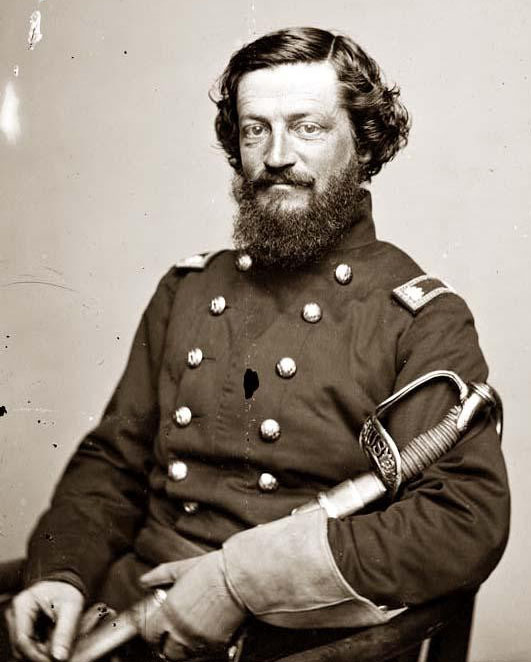
Colonel Thomas Kane
Thomas Kane
proved to be an invaluable friend to the Church. He loved the Mormon people and
did all in his power to protect them from the Federal Government. What was the
one aspect of the Mormons that touched the Colonel the most?
a.
Their
doctrine
b.
Their
prayers
c.
Their
singing
d.
Their
humility in persecution
Yesterday’s answer:
A Vinson Knight
Concerning
the extent of the ecclesiastical jurisdiction of these first two bishops, it is
necessary to remember that from 1831 to 1838 there were two headquarters of
Mormonism: one at Kirtland, Ohio, and one in Missouri. Whitney was bishop in
Ohio and Partridge was bishop in Missouri. Each had control over the temporal
affairs of his respective region; neither had jurisdiction over the entire
church. Their ecclesiastical authority was described in 1880 by Orson Pratt,
then the Church Historian:
“Here were two Bishops, then, one having
jurisdiction in the West, a thousand miles from the other; the other having
jurisdiction in the East. Their duties were pointed out, But neither of them
was Presiding Bishop [over the entire church]. But what were they? As was
clearly shown by President Taylor at the Priesthood meeting on last evening
they were general Bishops.”
In ecclesiastical authority, these two men
were performing regional functions rather than operating, according to the
definition of LDS General Authorities, as officers who presided over the entire
church.
Not until the church established its
headquarters at Nauvoo, Illinois, in 1839, was the office of bishop further
clarified. Beginning in 1839, two other bishops besides Partridge and Whitney
were ordained, and these four men were appointed to preside over ecclesiastical
wards. Within a year several more bishops were chosen to preside over wards.
The appointment of bishops to preside over such geographical subdivisions gave
a congregational or parochial responsibility to the office of bishop. This was
a delimitation of the broad regional authority previously exercised by Bishops
Partridge and Whitney. In Utah, the wards became independent ecclesiastical
units with a separate schedule of meetings for residents of the geographical
boundaries of the ward. In Nauvoo, however, the wards were apparently a
pre-congregations development, since devotional meeting were held on Sundays
for the entire population of Nauvoo, rather than by individual wards. Nevertheless,
giving the bishops economical and ecclesiastical responsibility for Mormons
living in a narrowly defined locality was an important step in the evolution of
the bishopric.
For a time, along with the local ward
bishops in Nauvoo, the previous regional bishops continued. The opportunity to
unify their role into a single presiding bishop was by-passed when, at the
death of Edward Partridge in 1840, George Miller was appointed by revelation on
January 19, 1841, to succeed him. But the need for a single authority over the
various classes of bishops was recognized in the same revelation:
“And again, I say unto you, I give unto you
Vinson Knight, Samuel H. Smith, and Shadrach Roundy, if he will receive it, to
preside over the bishopric.”
President John Taylor and three church
historians affirmed that, whereas Edward Partridge’s authority was only
regional, Vinson Knight was the first man to be designated as Presiding Bishop
of the Church.
Despite the e revelation designating Vinson
Knight to preside over all other bishops, Knight apparently never functioned as
the supreme Presiding Bishop over the church. Although information about Knight
from 1841 to his death in 1842 is sketchy, it appears that he was not allowed
to function as the supreme bishop in the church because of an act of
ecclesiastical presumption of his part. In the Times and Seasons of January 15, 1841, Knight announced that the
Aaronic Priesthood would be organized at his home on January 24, 1841. This
announcement was published by Knight to “reside over the bishopric.” Obviously
Knight was anticipating the appointment which later appeared in the dictated
revelation. Presumably Joseph Smith had given Knight some intimation that he
would be called to be a bishop to preside over all other bishops, and Knight
became overly anxious to exercise that authority.
In 1839, Joseph Smith had written a letter
in which he discussed the situation of men in the church exceeding the bounds
of their authority, using the words “many are called, but few are chosen.” That
decree apparently applied to Vinson Knight’s appointment as Presiding Bishop.
When announcement was made in Times and
Seasons on February 1, 1841, of the most important new appointments in the
recent revelation, there was no mention of Knight’s appointment, even though
George Miller’s lesser appointment to succeed Partridge was announced. Knight’s
January announcement indicated he planned to organize the Aaronic or Lesser
Priesthood himself on January 24, 1841. The meeting was not held as he
announced, presumably because it was not allowed. When the Aaronic Priesthood
was finally organized in Nauvoo, it was two months after the date Knight
designated. Instead of being under his single direction, as implied by his
announcement, the Aaronic Priesthood was organized under the joint direction of
Bishops Miller, Whitney, Knight, and one other bishop of Nauvoo. To his death,
Vinson Knight was denied the opportunity to receive the office of Presiding
Bishop, and the announcement of his death in the Times and Seasons simply referred to him as “one of the bishops of
this Church.” Although excluded from the supreme position to which he had been
authorized by revelation, Knight was advanced above the position of ward bishop
he had previously held. He became a General Bishop and acted in concert with
the two other General Bishops, Whitney and Miller.
For nearly five years following the death of
Knight in July 1842 no man was appointed to the position of Presiding Bishop of
the Church. Whitney and Miller continued their joint function as General
Bishops. Miller was the presiding officer of the high priests in the church,
and Whitney presided over the Aaronic Priesthood officers. In October 1844 they
were jointly appointed as Trustee-in-Trust for the church, following the death
of the former trustee, Joseph Smith. At that same conference, Whitney was
sustained as “first bishop” and Miller as “second bishop.” They did not,
however, form the unified quorum alluded to in the 1841 revelation, since each
of them was semi-autonomous, Whitney having one counselor, and Miller having no
counselors as bishop. Referred to as the presiding bishops” of the church,
these two men continued their semi-autonomous relationship to each other as
General Bishops, even though Whitney was designated First Bishop in 1844,
honoring him as the bishop of longest tenure in the church.
Following the exodus of the Mormons from
Nauvoo in February 1846, Whitney gained increasing eminence and ultimately
became the Presiding Bishop of the Church. George Miller began demonstrating
resistance to the leadership of Brigham Young, and rapidly fell out of favor
with his administration. Miller was specifically invited to attend the general
conference of April 6, 1847. Failing to attend, Miller’s name was omitted from
the list of officers, and Whitney was sustained as Presiding Bishop of the
Church. Although the office had been authorized by the 1841 revelation, Whitney
was the first man actually to function in that position. By 1847, the duties of
the bishops to preside over the Aaronic priesthood and administer the finances
of the church had been so well developed that the duties of the Presiding
Bishop of the Church were obvious.
Journal of Mormon History, D. Michael Quinn, The Evolution of the
Presiding Quorums of the LDS Church, Vol.1 1974, 34-7.


No comments:
Post a Comment